



Ex vivo vs in vivo CAR-T and gene therapy.
28 Sept, 20267 minutesAutologous cell therapy works, 17 approved by the FDA so far, the constraint has always been...


Autologous cell therapy works, 17 approved by the FDA so far, the constraint has always been the manufacturing chain around it.
In 2026, big pharma stopped hedging on whether that can work. Lilly agreed to pay $3.25 billion upfront, and up to $3.25 billion more in milestones, for Kelonia Therapeutics, the biggest deal to date in the race to reprogram immune cells directly in patients.
In vivo CAR-T and in vivo gene editing try to remove that chain by having the patient's own body do the engineering step. For Tech Ops and CMC leaders, this shift changes what the product is, how it is made and released, and which people you need to make it.
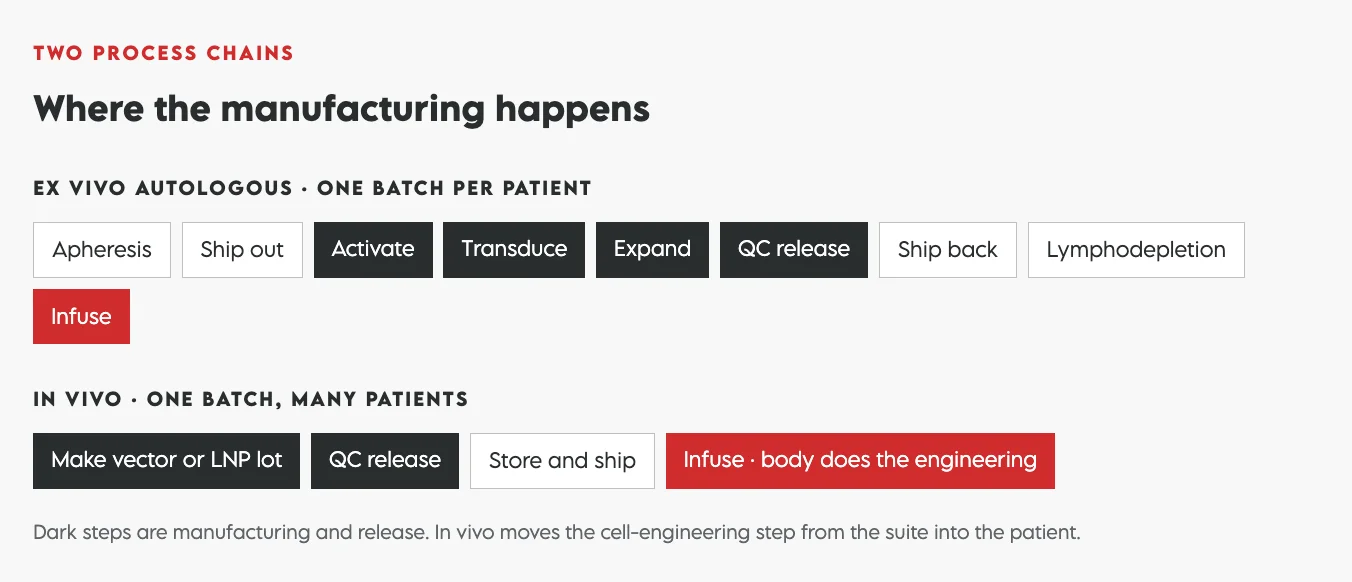
What in vivo changes.
In vivo CAR-T there is no apheresis, no per-patient batch and, for some platforms, no lymphodepletion step. The product starts to look like a conventional off-the-shelf biologic: one lot, released once, treating many patients.
But it’s early days, the furthest along so far is Kelonia’s KLN-1010 (a lentiviral vector, in multiple myeloma now being acquired by Lilly).
AbbVie bought Capstan for $2.1 billion, Bristol Myers Squibb acquired Orbital for $1.5 billion and AstraZeneca picked up EsoBiotec for $1 billion. Gilead bought Interius for $350 million and, through Kite, struck a deal with Pregene worth up to $1.6 billion. Lilly bought Orna for up to $2.4 billion before its Kelonia deal. J&J followed in July, paying $785 million upfront, including a $465 million equity investment, for an option to acquire Sail Biomedicines.
In vivo gene editing is further along. Intellia's lonvo-z, which uses LNP-delivered CRISPR to switch off a disease-causing gene in the liver, has a BLA under review with a PDUFA date of 10 March 2027. It isn't a cell therapy, but it shows that a non-viral, in vivo genetic medicine can reach a filing.
What it means for Tech Ops and CMC.
For a Tech Ops organisation, the 2 skill sets that are variable are process and analytical development.
The shift that matters most is potency. For an in vivo product, the therapeutic cell does not exist until after infusion, so the release assay has to predict what will happen inside the patient. That is a harder analytical problem, and it lands on QC and analytical development first. The second shift is scale. An in vivo lentiviral programme needs more vector, made to a higher specification (vector process development), than an ex vivo programme does.
Which skills transfer.
Lentiviral vector process development and analytics move across well; ex vivo teams already make vectors, and in vivo lentiviral platforms need more of it, to a higher specification. Regulatory CMC experience with CGT filings transfers directly, and Intellia's filing shows that experience will soon cover in vivo products too. LNP formulation, lipid and mRNA analytics, and large-scale nucleic acid manufacturing sit mainly in RNA therapeutics and vaccines. That is where the RNA-LNP camp will recruit. Those pools are larger than the CGT pool, but candidates won’t necessarily know the regulatory expectations of a gene therapy.
Where hiring gets harder.
Two things make hiring harder: consolidation means the most experienced in vivo teams now sit inside large pharma, and the scarcest profile, an analytical lead who can build a potency assay for a product that works inside the patient is needed by every in vivo programme at the same stage.
Which skills transfer, and which do not.
As in vivo platforms move closer to commercialisation, the skills required across CMC, Tech Ops, MSAT and analytical development are changing with them; we are helping companies identify where deep CGT experience is essential and where adjacent expertise from RNA therapeutics can strengthen the team.
Building for in vivo?
As in vivo platforms move closer to commercialisation, the skills required across CMC, Tech Ops, MSAT and analytical development are changing with them.
We place Tech Ops, CMC, MSAT and analytical leaders across cell and gene therapy in the US, UK and EU.
Holly Wallner, Associate Director and Global Client Partnerships, can walk through which of your seats need CGT experience and which can come from RNA or vaccines.