Is Your Medical Device Sales Team Ready for Launch?
28 Oct, 2026



Quick answer: in medical device executive search, boards look for a leader whose experi...


Quick answer: in medical device executive search, boards look for a leader whose experience fits the company's next three to five years, not its last three. That means defining the business stage, product portfolio, funding position, operational priorities and leadership expectations before approaching anyone. A clear leadership brief then separates essential experience from preferences that only narrow the field.
Appointing a chief executive, commercial director or head of quality is one of the most consequential decisions a medical device board makes. Yet many searches start with a job description adapted from the last hire, or a list of every quality the board would like. The result describes an ideal person rather than the role the business needs filled.
Good governance points the same way. The UK Corporate Governance Code says board appointments should follow a formal, rigorous and transparent procedure, based on merit and objective criteria (FRC). The Code is written for listed companies, but the principle suits any business: decide what the role requires before deciding who might fill it.
This guide to medical device executive search is for boards and investors planning a senior appointment. It draws on how Board & Executive Partners, the life sciences executive search practice of Barrington James, works with boards to define senior roles. It sets out the questions to answer first, how to tell essential experience from a wish list, and what a strong leadership brief contains.
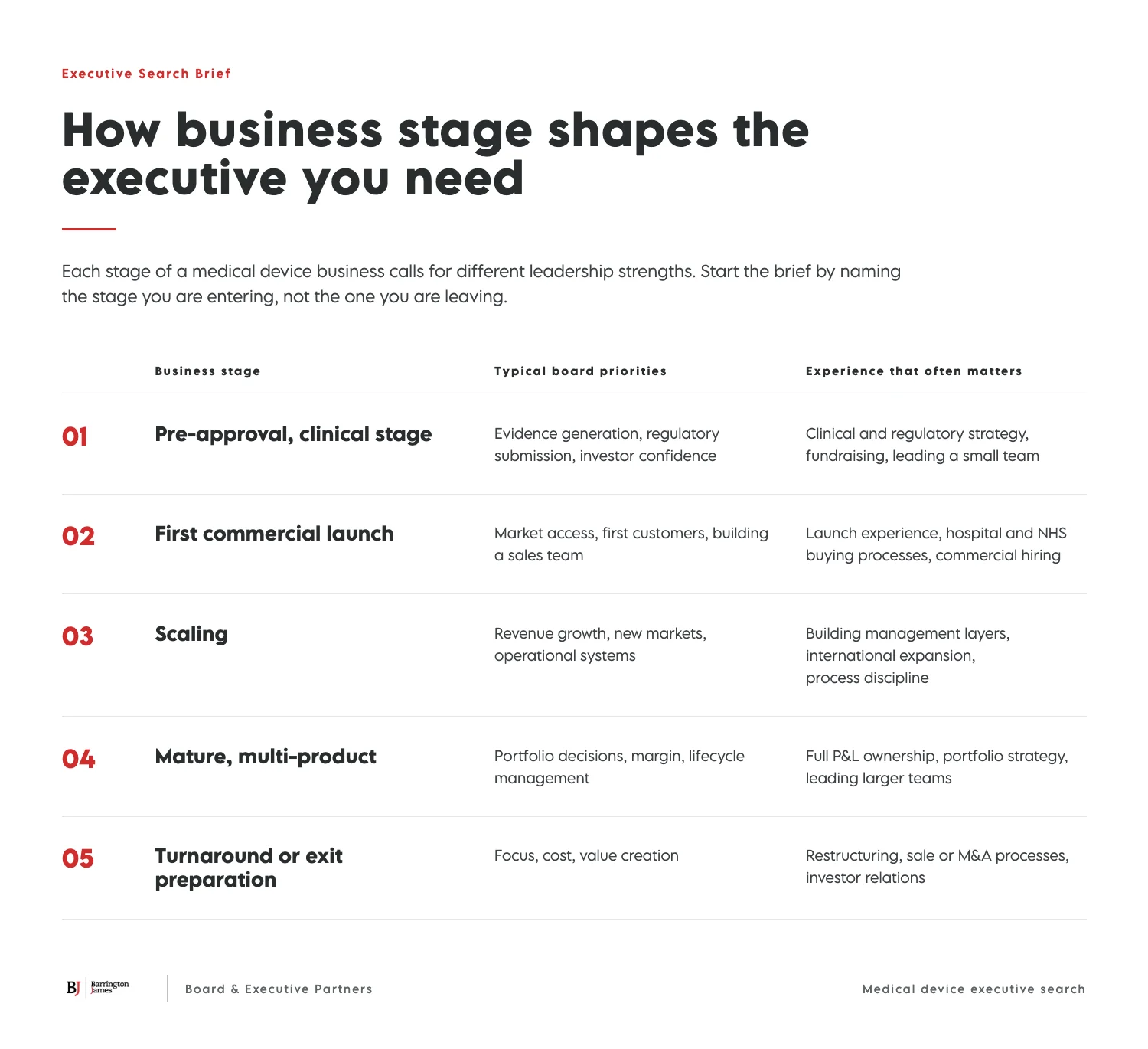
Illustrative example: a clinical-stage company with one device under regulatory review may be drawn to a chief executive from a large medtech group. That candidate may have run a big P&L but never raised money or worked without functional support. A leader who has taken a device through approval in a smaller business may be the better fit, even with a smaller title. Barrington James's executive search team works with companies from early funding rounds through to launch and global multinationals, so it can identify leaders who have succeeded at the same stage.
The portfolio decides which technical, clinical and commercial knowledge the executive needs. Ask what the company sells, to whom, and how that will change over the next few years.
Useful questions include:
Illustrative example: a company moving from one capital system to a recurring consumables model needs a leader who understands service, pricing and long-term contracts, not only large one-off sales.
Therapy-area experience is often given too much weight. Ask whether the leader must know the clinical area on day one, or whether they need to know how to build a business around a device of this type and risk class.
Funding position shapes how much risk, runway and investor scrutiny the new executive will face. In medical device executive recruitment, it is often one of the first things strong candidates ask about.
Illustrative example: a private equity backed business planning an exit in three years needs a leader comfortable with a fixed value-creation plan and close investor oversight. A founder-funded company may value patience and hands-on product involvement more.
Be candid about runway. Senior candidates will ask, and a clear answer builds trust early in the process.
Name the two or three operational problems the new leader must solve in their first 18 to 24 months. These priorities, more than the job title, show which experience is essential.
Common priorities in medical device businesses include:
Illustrative example: if the next two years depend on fixing a quality system after an audit finding, a strong commercial leader with no quality experience is a real risk, however impressive their sales record.
Boards should agree how the new executive will work with them, not only what they will deliver. Mismatched expectations can undermine an appointment even when the skills are right.
Agree these points before approaching candidates:
Illustrative example: if a founder is stepping back to become chair, agree in writing who leads investor relationships and product decisions. Candidates will test this at interview, and ambiguity can put strong people off.
Link every requirement to a specific outcome the business needs. If a requirement cannot be tied to an objective in the first two years, it is probably a preference rather than a necessity.
Wish lists usually grow by addition: each board member adds a quality and nobody removes one. The result can describe a candidate who barely exists, slow the search and narrow the range of backgrounds considered. Some roles, particularly in regulatory affairs and quality, usually need direct device experience; others, such as finance or operations, can draw on adjacent sectors through life science executive search.
Three quick tests help:
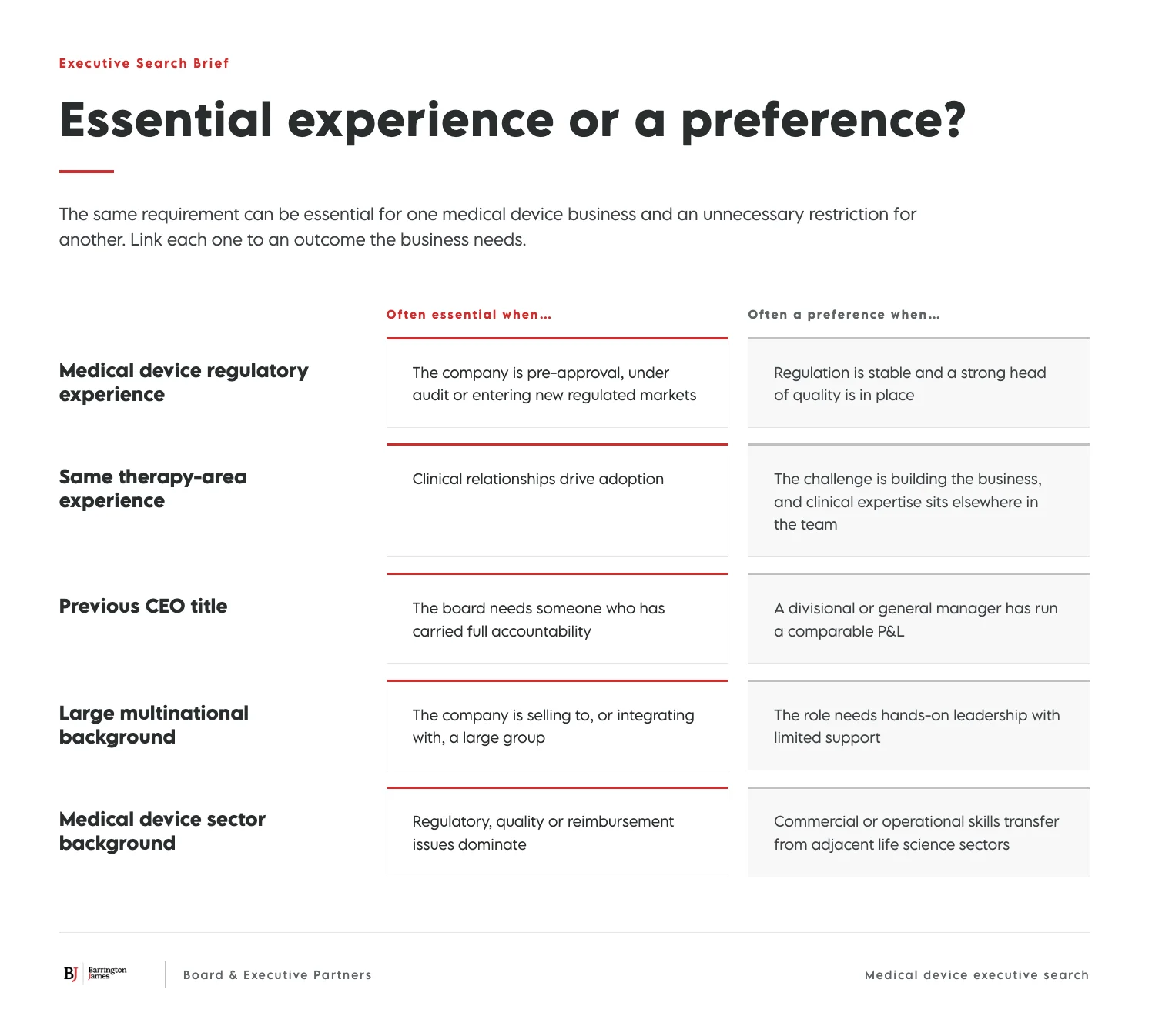
Illustrative example: a board asks for a chief executive with orthopaedic experience, a previous exit, US launch experience, a private equity background and a UK base. Each is reasonable alone; together they may describe only a handful of people. Ranking them, and keeping two or three as essential, widens the field without lowering the bar. Where sector background is a preference rather than a requirement, a broader life science executive search can widen the pool further.
The strongest searches start with a written brief the whole board has agreed. Medical device executive search firms add most value at this stage, before any candidate is approached, by testing assumptions and turning priorities into clear criteria. At Barrington James, every executive search assignment starts this way. The team works with client stakeholders to analyse the strategic context, then produces a position specification, key assessment criteria, an assignment brief and a target universe (a map of the companies and leaders the search will cover). The client signs these off before any candidate is approached.
A strong leadership brief covers seven things:
Medical device executive search firms often approach leaders who are not actively job hunting, so a clear, credible brief matters from the first conversation. From a consultant's perspective, four habits make the biggest difference:
In medical device executive search, the quality of an appointment is largely set before the first candidate conversation. A board that has agreed the business stage, portfolio, funding position, operational priorities and leadership expectations can judge every candidate against the same clear standard. An agreed brief also keeps medical device executive recruitment on schedule, because it is one of the few timing factors the board fully controls.
If you are planning a senior appointment, speak to specialist medical device executive search firms early. Board & Executive Partners, the executive search practice of Barrington James, works only in life sciences, with teams across North America, Europe and Asia Pacific. Our partners help boards test the brief, map the market and decide which requirements are truly essential. They then manage the process through shortlist, referencing, offer and onboarding, including the often long notice period. Whether the role calls for deep device expertise or a wider life science executive search, a clear leadership brief gives the board the best chance of making the right appointment. Speak to our board and executive search team to talk through your next leadership hire.