


World AMR Awareness Week 2026: Why Antimicrobial R&D Talent is so Hard to Hire
10 Nov, 20265 MinutesEvery year from 18 to 24 November, World AMR Awareness Week asks governments, health systems...

Every year from 18 to 24 November, World AMR Awareness Week asks governments, health systems and industry to take antimicrobial resistance (AMR) seriously. This year's theme is "One Health, one action: Prevent AMR now", and it lands alongside the WHO's new Global Action Plan on AMR for 2026 to 2036.
The Scale of the AMR Problem
Most of the conversation will rightly focus on stewardship, surveillance and the drugs we need. We want to look at something that gets far less attention: the people. New antibiotics, antifungals and diagnostics come from a small, highly specialised group of scientists, clinicians and drug developers. That group is shrinking, and hiring into infectious disease and antimicrobial R&D is now one of the toughest challenges in biotech recruitment.
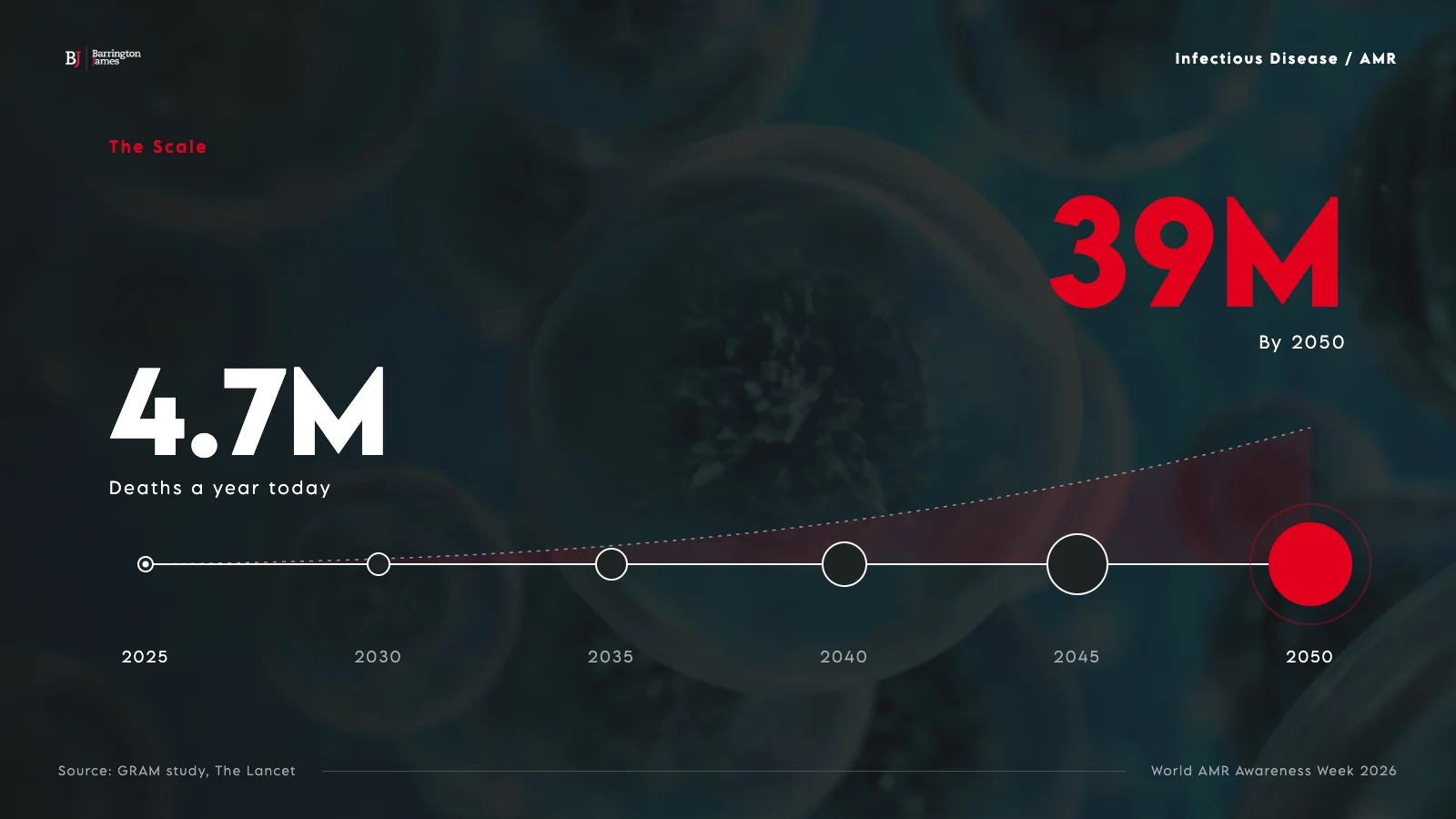
Antimicrobial resistance is no longer a future threat. Bacterial AMR is already associated with more than 4.7 million deaths a year. The Global Research on Antimicrobial Resistance (GRAM) study, published in The Lancet, forecasts more than 39 million deaths directly caused by resistant infections between 2025 and 2050, and AMR playing a part in a further 169 million.
The same study gives a reason for hope. A steady supply of new antibiotics targeting Gram-negative bacteria could prevent around 11 million of those deaths. That depends on a healthy R&D pipeline, and that is where things get difficult.
An Antibiotic Pipeline Ender Pressure
The WHO's 2025 review of antibacterial development found 90 agents in clinical development, down from 97 in 2023. Only 15 of those count as truly innovative. Since 2017, 17 new antibacterials for priority pathogens have been approved, and only two of them belong to a new chemical class.
There is plenty of early-stage activity, with 232 preclinical programmes across 148 organisations. But most of that work is happening in small and medium-sized biotechs, and the WHO warns that many of them risk running out of money before their science reaches patients.
That matters for hiring. When the work sits in small, thinly funded companies, the jobs are less secure, the teams are leaner and the expertise is spread across far fewer organisations.
The AMR Talent Shortage: A Workforce that has been Quietly Leaving
The AMR Industry Alliance's Leaving the Lab report put numbers to what many in the field already suspected...
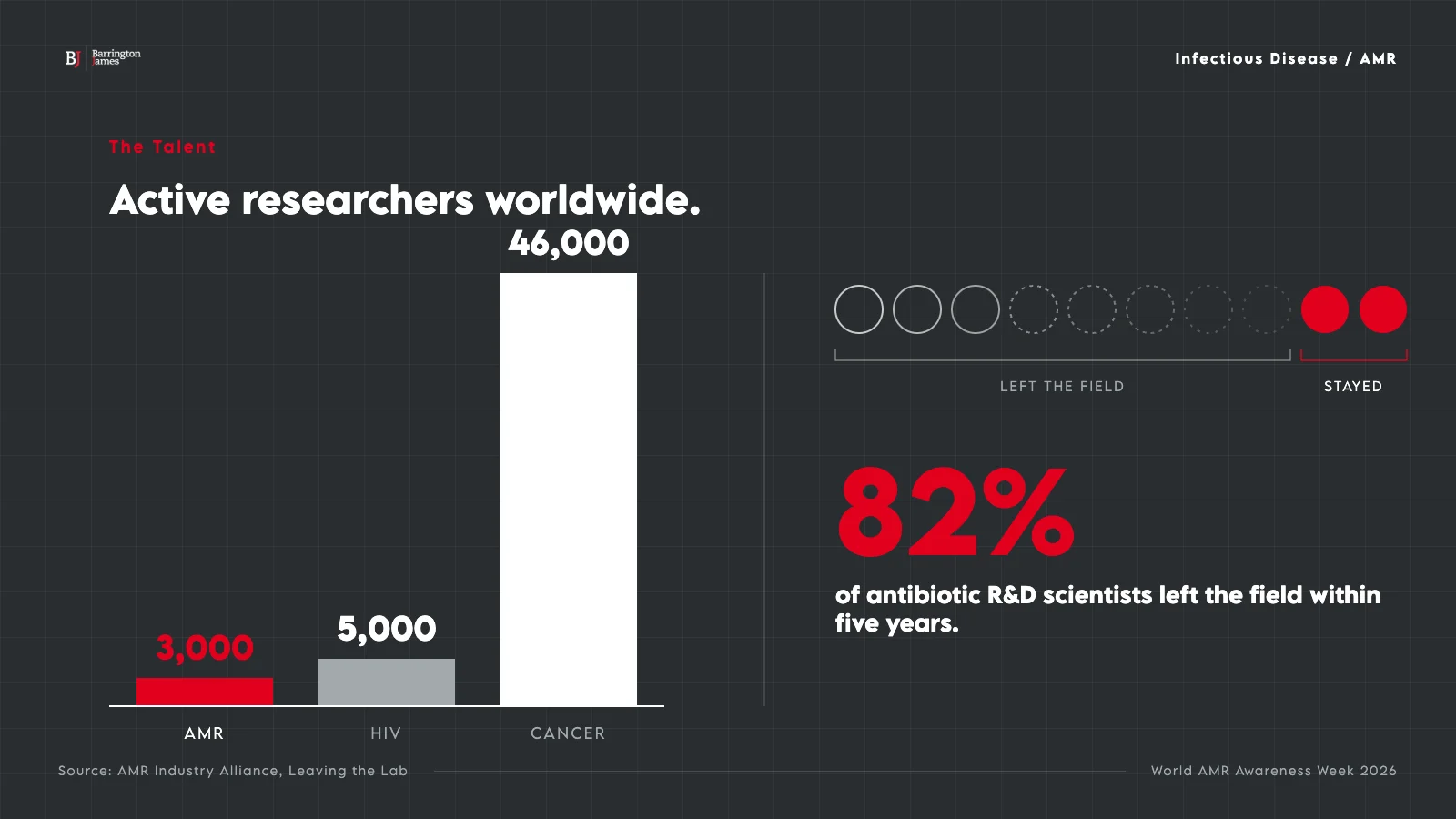
The cause is largely economic. New antibiotics are held in reserve to slow resistance, so they sell in low volumes and rarely earn back what they cost to develop. Several companies that won approval for a new antibiotic later went bankrupt, and very few large pharmaceutical companies still have an antibiotic in clinical development. Talented people have followed the funding into oncology, immunology and other areas.
The clinical side has the same problem. In the US, around half of infectious disease fellowship places went unfilled in 2024, partly because ID physicians are among the lowest-paid specialists.
Why Infectious Disease and Antimicrobial Roles are so Hard to Fill
When our clients hire in this space, the same challenges come up again and again.
- The talent pool is tiny. For many roles, the number of people with directly relevant, hands-on experience runs into the dozens, not the hundreds. People who have taken an antibacterial from discovery to approval are rarer still.
- The skills are highly specific. Medicinal chemistry for Gram-negative bacteria, where getting a molecule through the cell wall is a field in itself, is not the same as general small-molecule chemistry, which is why drug discovery and preclinical hires in AMR take so long. Antimicrobial PK/PD modelling, clinical microbiology, and running trials in hospital-acquired pneumonia or complicated urinary tract infections all need experience that transfers only partly from other therapy areas. The same goes for clinical development, clinical operations and regulatory affairs professionals with anti-infective experience.
- Candidates are wary of instability. Many experienced people have lived through a company closure or a programme being shut down. Before they move, they want to know how a role is funded and how long the runway is.
- The mentoring gap is growing. As senior scientists retire or leave, there are fewer people to train the next generation. That makes mid-level talent scarce as well as senior talent.
- Pay competition is real. Oncology and other well-funded areas can often pay more, and AMR employers are competing for the same transferable skills.
What is Starting to Change
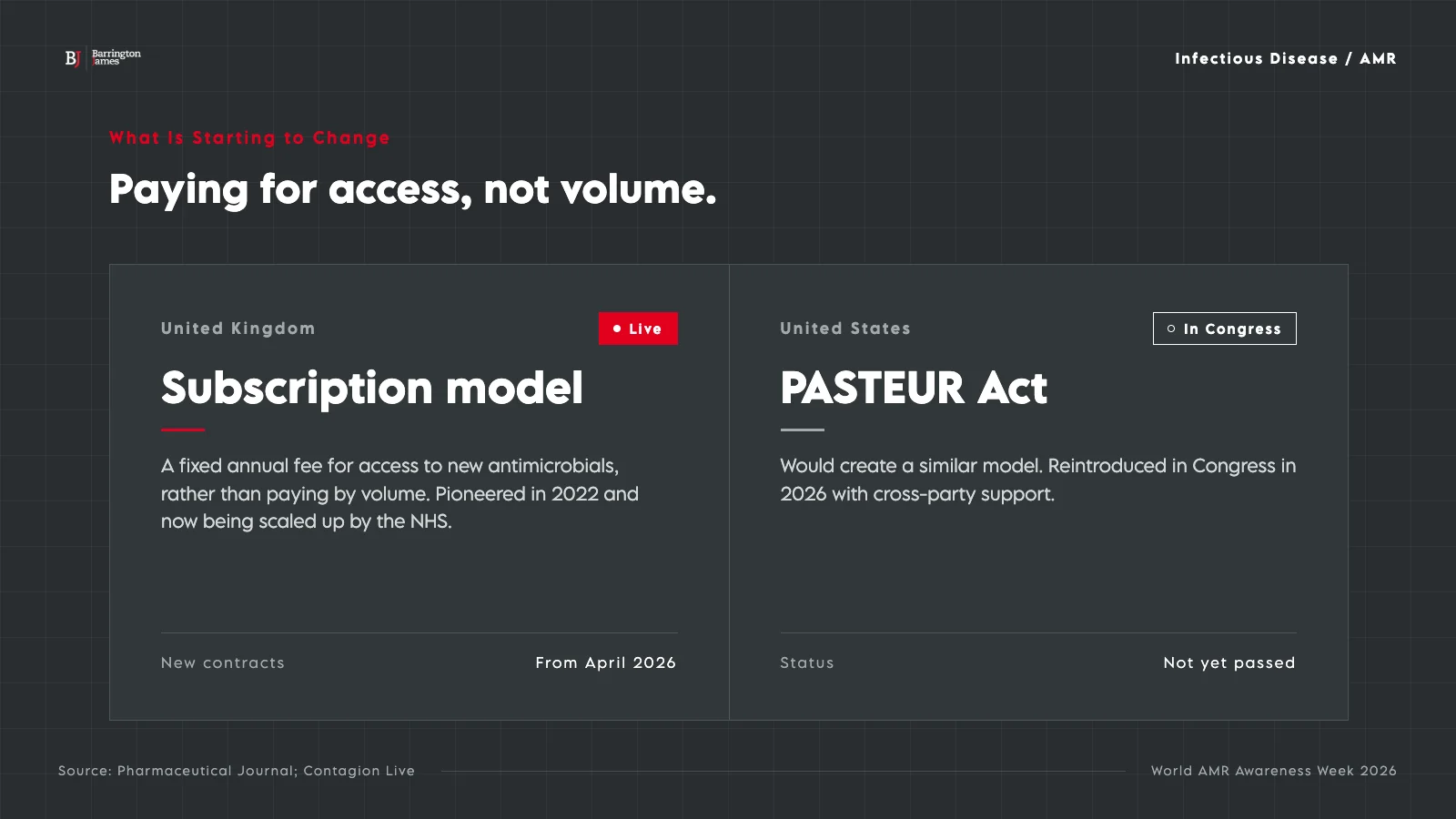
There are signs of progress. The UK pioneered a subscription-style payment model in 2022, paying companies a fixed annual fee for access to new antimicrobials rather than paying by volume. The NHS is now scaling it up, with a new round of contracts running from April 2026. In the US, the PASTEUR Act, which would create a similar model, was reintroduced in Congress in 2026 with cross-party support, though it has not yet passed.
Non-profit funders such as CARB-X and the AMR Action Fund continue to back antibiotic R&D and help keep scientists in the field. If these pull incentives take hold, they could give companies the stability to build long-term teams, and give scientists a reason to stay. That will also create demand for market access and HEOR specialists who understand these new reimbursement models.
How Hiring Managers can Compete for AMR Talent
If you are building a team in infectious disease or antimicrobial R&D, a few things make a real difference:
- Look at adjacent skill sets. Scientists from antifungal, antiviral, TB, vaccines or anti-infective diagnostics often bring highly relevant experience. Strong candidates from other therapy areas can be brought up to speed with the right support.
- Be open about funding. Explain your financing, partnerships and runway early in the process. In this market, transparency is a selling point.
- Lead with the mission. Many people in AMR chose the field because it matters. Make the impact of the role clear.
- Be flexible on location and structure. With such a small talent pool, insisting on one site can rule out your best candidates. Contract and interim recruitment can also fill critical gaps quickly, and executive search helps when you need proven leadership.
- Move quickly. Good AMR candidates are rarely on the market for long. A slow process loses people.
- Invest in development. Mentoring and clear career paths help you keep the people you hire and build the next generation of AMR expertise.
For Candidates: Your Skills are Needed
If you work in microbiology, infectious disease, anti-infective drug development or a related field, your experience is in demand. And if you are working in a neighbouring area and wondering whether AMR could be for you, many of your skills will transfer. There are few fields where your work could have a more direct effect on global health.
Frequently Asked Questions
- When is World AMR Awareness Week 2026?
World AMR Awareness Week runs from 18 to 24 November 2026. The theme is "One Health, one action: Prevent AMR now".
- Why is there a shortage of antimicrobial researchers?
New antibiotics rarely make a profit, so investment has moved to other disease areas. Many companies have closed or cut programmes, and experienced scientists have left the field or retired.
- Which AMR roles are hardest to hire for?
Medicinal chemists with Gram-negative experience, clinical microbiologists, antimicrobial PK/PD specialists, and clinical development and operations professionals with anti-infective trial experience are among the hardest to find.
- How can employers attract AMR talent?
Widen the search to adjacent fields, be open about funding and runway, offer flexibility on location, and run a fast hiring process.
Talk to us
Barrington James works with biotech, pharma, non-profit, academic and government organisations hiring across infectious disease, microbiology and anti-infective drug development. Whether you are building a team or considering your next move, get in touch with our team for a confidential conversation. You can also read more on our life sciences recruitment blog.
Related Posts

The Rise of the Forward Deployed Engineer.
28 Jul, 2026
